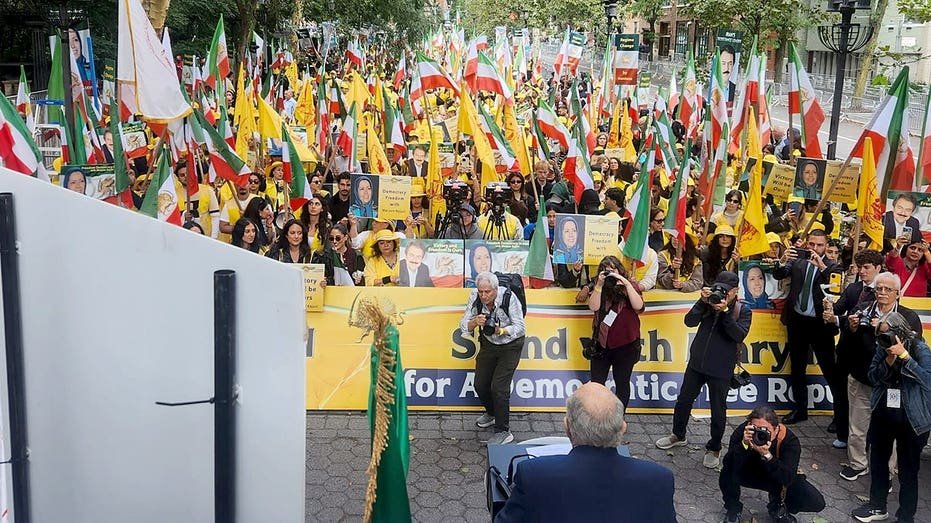
Iran’s Alaj platform crowdsources diaspora surveillance via Telegram, with an official source confirming the system to Fox News Digital.
Iran has promoted a new system encouraging citizens to report information about Iranians living abroad, effectively crowdsourcing surveillance of the diaspora through a website and messaging platforms including Telegram, according to Iranian media reports and an Iranian official source who confirmed the program to Fox News Digital.
The platform, known as Alaj — Persian for “remedy” or “cure” — asks users to provide information on people overseas whom it accuses of acting against Iran’s national interests or security. Iran International reported that tips could be submitted through the Alaj website, a Telegram bot and Iran’s Bale messaging service. The outlet reported that Iranian state television and the Revolutionary Guard-affiliated Fars News Agency also promoted the initiative.
An Iranian official source confirmed to Fox News Digital that Alaj and the Telegram chatbot were established as a new system through which certain individuals could report information about Iranians living abroad. The source said the website was subsequently taken down after the project drew significant criticism inside Iran.
The website did go offline shortly after its public rollout, although the reason for its suspension remains disputed.
Iran International reported that Alaj claimed to have identified and monitored 1,600 people, including roughly 600 identified through reports submitted by members of the public. Those numbers have not been independently verified. The platform published names and photographs of Iranians abroad and, in some cases, national identification numbers, dates of birth and fathers’ names, according to the outlet.
For Iranian-American journalist and foreign policy analyst Lisa Daftari, the most consequential element is not simply that Tehran is collecting information, but that it is asking Iranians to report on one another.
“Even if it’s just the perception that other Iranians can report you or can get you in trouble or that this app exists, it makes a lot of people fearful,” Daftari told Fox News Digital. “You’ll think twice before going to that next protest.”
‘KEEP A LOW PROFILE’: STATE DEPARTMENT WARNS AMERICANS OVERSEAS THEY COULD BE TARGETED
Daftari said the fear is particularly acute for members of the Iranian diaspora who still have relatives inside the country.
“Now your face could be captured, you can get in trouble,” she said. “If you have family in Iran, they can get into trouble.”
Daftari described the approach as a digital extension of a much older system of control, arguing that Iran’s clerical establishment has spent decades creating uncertainty over whether neighbors, colleagues or acquaintances might report one another to authorities.
“Now the regime wants to take this show on the road and do that here, here in the West,” Daftari said. “They want to intimidate people. And it works.”
SECRET SERVICE AWARE OF IRANIAN VIDEO THREAT TARGETING BARRON TRUMP, AGENCY SAYS
Daftari said she has experienced that intimidation personally for years. “I’ve been followed, I’ve been hacked multiple times, I have been approached in person in L.A., in New York, even at the airport,” she told Fox News Digital.
She said that after one major hacking incident compromised her social media accounts as well as her personal and professional email, she was contacted by her local FBI office and began working closely with agents.
Daftari said hackers also obtained private photographs of her in a bikini while she was on vacation and sent them to her husband. “The message they want to send is very clear, that we know where you are, we can reach you,” she said. “And obviously the point is to intimidate and silence those who speak out, who report, who speak the truth and talk about all the crimes of this regime.”
She said the effects extend beyond prominent journalists or activists. Years ago, while filming at a Los Angeles cafe where Iranian Americans were watching a World Cup game, Daftari said she saw people attempting to hide their faces from the camera out of fear that footage could reach Iran and expose relatives there to retaliation.
The calculation, she said, illustrates why a system such as Alaj can have an impact even if a target never knows whether information about them has actually been submitted.
IRAN’S PROXY WAR HAS CROSSED OCEANS AND IS NOW KNOCKING ON AMERICA’S DOOR
The threat has also changed Daftari’s own behavior.
She recalled being unable to stop thinking about security when the location of her father’s memorial service had to be announced publicly after his death. Daftari said she routinely considers where she parks, what details she shares online and security vulnerabilities at places she visits. “It does silence a lot of people and it does change the freedom by which we think we can operate here in the United States where we believe we have full freedom,” Daftari said.
“Their intimidation works,” she added. “It works to a certain extent on each individual.”
Daftari said the broader campaign should also shape how Americans understand the confrontation with Tehran, arguing that the threat extends beyond Iran’s nuclear program.
“It’s not just about nuclear weapons, it’s about a deadly ideology that has made its way here to U.S. soil,” she said. “We have to understand that.”
dcabd496-0a8b-5693-b480-5cc860a6c9a4, fnc, Fox News, fox-news/politics/defense/wars/war-with-iran, fox-news/world, fox-news/world/world-regions/middle-east, fox-news/world/conflicts/iran, fox-news/world, article