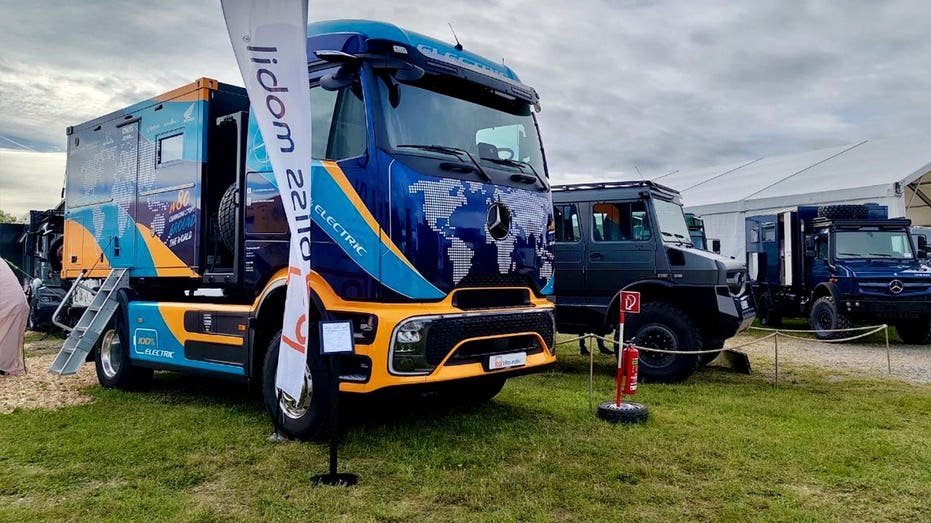
The Mercedes-Benz eActros 600 electric truck targets 621 miles per charge on a 28,000-mile round-the-world journey through over 30 countries.
If you think you’ve seen some wild RVs, this one may reset the scale. Professional truck driver and content creator Tobias Wagner, better known online as Elektrotrucker, is preparing to drive around the world in a specially converted Mercedes-Benz eActros 600. A full Bliss Mobil living module sits behind the cab, turning this electric truck into a rolling home. Wagner plans to make the entire journey on battery power.
Mercedes-Benz Trucks says the route will cover about 28,000 miles through more than 30 countries over roughly one year, with a goal of no more than 80 charging stops. According to Mercedes, the trip would be the first known circumnavigation of the globe in a fully battery-electric truck. What really caught my attention is how far Wagner hopes to go between those stops. Here’s how this massive electric motorhome works and why its 621-mile range target could be the toughest part of the trip.
100 KODIAK DRIVERLESS TRUCKS ARE HEADED FOR PUBLIC ROADS
NEW! 🩺 Free CyberGuy LIVE class: Get Better Healthcare With AI Saturday, September 26 at 11 a.m. ET / 8 a.m. PT
Kurt “CyberGuy” Knutsson will show you five practical ways AI can help you organize your health history, remember important appointment details, understand complicated medical information, research prescriptions and prepare smarter questions for your doctor. No technical experience is needed.
Save your free spot at CyberGuyLive.com
Underneath the living quarters sits the Mercedes-Benz eActros 600, a battery-electric truck built for long-distance commercial freight. Its three lithium iron phosphate battery packs provide a combined installed capacity of 621 kWh. Mercedes normally designs the truck to travel about 310 miles under specific fully loaded long-haul test conditions.
Wagner’s expedition truck has a very different job. Instead of pulling a heavily loaded commercial trailer, it carries a custom living module. Mercedes also modified the truck with single rear tires and expedition equipment. Those changes help reduce weight and rolling resistance compared with a traditional freight configuration.
The finished expedition vehicle reportedly has a maximum weight of about 34,170 pounds. Power comes from Mercedes’ electric axle and four-speed transmission. The eActros 600 produces about 536 horsepower continuously, with peak output reaching roughly 805 horsepower. That’s a lot of muscle for a vehicle carrying its own kitchen and bed.
This is where the project gets especially interesting. Wagner and Mercedes believe the lighter expedition setup, combined with careful hypermiling, could potentially travel as far as 621 miles on a single charge. That would be roughly double the range Mercedes quotes for a fully loaded eActros 600. Mercedes says the lighter expedition vehicle should significantly exceed the eActros 600’s normal long-haul range. How close he gets will depend on road conditions, temperature, speed and terrain.
Wagner wants to travel about 28,000 miles while stopping to charge no more than 80 times. That works out to an average of roughly 350 miles of driving per charging stop, although the actual distances will vary considerably along the route. Some stretches could become much more challenging.
The expedition will cross regions where high-powered truck charging remains difficult to find. The latest route includes Central and East Asia, Australia, the United States and several countries in Latin America. That’s where stretching the truck well beyond its normal freight range could become useful.
ROBOTAXI PIT STOPS COULD POP UP NEAR YOU
Eventually, even this giant battery has to plug in. The eActros 600 supports CCS2 fast charging at up to 400 kW. Mercedes says that level of charging can take the battery from 10% to 80% in about 70 minutes under its specified conditions. Mercedes has also demonstrated Megawatt Charging System technology at up to 1,000 kW, which can cut charging times dramatically on compatible equipment.
Wagner’s expedition setup has also been prepared for different charging systems around the world. It includes charging connections positioned on both sides of the truck. The project also has adapters designed for charging infrastructure in China and North America. That flexibility could prove essential once the truck leaves Europe. Mercedes revealed another important backup. Wagner has equipped the truck with his own Alpitronic DC charging station. That lets him charge from AC connections at up to 43 kW in special situations when conventional high-powered truck charging is not available.
Bliss Mobil added a roughly 13-foot expedition module behind the cab. Inside, Wagner gets a U-shaped dining area along with a kitchen. A bathroom sits toward the rear. There’s also a drop-down bed that stores above the dining area when he wants more room during the day. The camper can sleep as many as four people. Wagner will have considerably more room because his primary travel companion is his dog, Krümelix.
The living module also follows the electric theme. It uses a separate 400-Ah lithium battery supported by 1,000 watts of solar power. That system handles equipment such as the induction cooktop, refrigerator and air conditioning. It also powers other onboard systems without relying on diesel or propane. The motorhome reportedly carries about 106 gallons of fresh water. A multistage filtration system helps Wagner manage water during extended stretches away from traditional campgrounds.
Bliss Mobil designed the expedition module as a largely self-contained unit. Its electrical and plumbing systems sit within the camper rather than depending on the truck itself. That approach allows Bliss Mobil modules to move between compatible truck chassis.
Wagner’s module does have a 24-volt connection to the eActros. That means the living area can draw energy from the truck’s main battery when necessary. Still, the expedition has an obvious reason to conserve that electricity. Every bit of power used inside the camper could otherwise help move a nearly 17-ton vehicle farther down the road.
A giant expedition truck can handle plenty of roads, but there will always be places where its size becomes a problem. Wagner has another electric solution for that. A motorcycle carrier on the back holds a Honda WN7 electric motorcycle. When the road becomes too tight for the eActros, Wagner can leave the motorhome behind and continue on two wheels. The motorcycle uses a 9.3-kWh battery and produces about 67 horsepower. It’s a useful backup for a trip designed to reach places far beyond normal highway rest stops.
TOYOTA JOINS HYDROGEN TRUCK ALLIANCE PUSH
None of this comes cheaply. A price sheet displayed with the vehicle broke down the cost of the eActros 600 truck, Bliss Mobil camper and additional equipment. The total is approximately $796,600 including tax based on the exchange rate used at the time. Call it nearly $800,000. The Honda electric motorcycle wasn’t included in that figure.
Of course, this also isn’t a production RV you can configure at your local Mercedes dealership. Wagner’s vehicle is a specialized one-off expedition build created around a commercial electric truck. We’ve seen other companies rethink how electric vehicles fit into camping. The CyberTrailer takes a different approach, using solar power and an onboard energy system to support off-grid travel.
Mercedes-Benz Trucks says Wagner will officially depart from IAA Transportation 2026 in Hanover, Germany, on Sunday, Sept. 20. From there, the trip is expected to last about a year. Mercedes says Wagner will travel through around 30 countries on five continents while putting battery-electric truck technology through real-world conditions well beyond familiar European freight routes. Mercedes says the planned route may still change as the trip progresses. The vehicle may be built for an extraordinary adventure, but the results could tell us something much bigger about electric transportation.
You probably won’t be putting an $800,000 electric expedition truck in your driveway. Still, this trip could answer questions that eventually affect far more ordinary electric vehicles. Range is only part of the EV equation. Reliable charging becomes even more important when you leave major highways or travel through areas with limited infrastructure. Wagner will be testing both. If the eActros can consistently travel well beyond its standard commercial range, engineers will get another example of how vehicle weight and driving technique can change battery performance.
The charging side may prove equally revealing. A vehicle can carry an enormous battery, but long-distance travel still depends on finding equipment powerful enough to recharge it. Wagner’s onboard charging equipment gives him another option when high-powered public chargers are unavailable, but slower charging could add considerable time to the trip.
We have already seen experiments that attack the charging problem from another direction. One electric road project is testing technology that can transfer power to vehicles while they drive. Wagner’s trip takes the opposite approach. He is bringing a huge battery and finding out how far today’s infrastructure can take it.
I love a good road trip, but this one takes the idea to another level. What fascinates me most isn’t simply whether Wagner can squeeze 621 miles out of this massive battery. I want to see what happens when he leaves the easy charging routes behind and has to make this technology work across more than 30 countries. That’s where this trip could get really interesting. A giant battery and impressive range numbers are great, but you still need a working charger when you pull in. If Wagner can circle the globe with roughly 80 charging stops, that’s a pretty strong demonstration of how far electric trucking has come. And if he gets stranded looking for power along the way, we’ll learn something from that, too.
If an electric motorhome could take you 600 miles between charges, would you trust it for a cross-country road trip, or would finding the next charger still hold you back? Let us know by writing to us at Cyberguy.com
Sign up for my FREE CyberGuy Report
Copyright 2026 CyberGuy.com. All rights reserved.
555f159d-bf98-5fac-81b5-375cc4d3bf44, fnc, Fox News, fox-news/auto/attributes/electric, fox-news/auto/make/mercedes-benz, fox-news/auto/style/trucks, fox-news/world/disasters/transportation, fox-news/special/sponsored/road-trip, fox-news/tech, article